2 year old, and the hole in the teeth??
2. may 2012
Filed in Other questions
Question:
Hello.....
Sitting here with the worst feeling ever... the Feeling of, to be the worst mother!!!
My daughter, 2 years old, has had “teething problems” with regards to teeth brushing... It was with the “abuse” that I had brushed her teeth. But the last few years there is progress, as long as she is a part of it, and looking in the mirror... And ends ALWAYS with yourself, to brush her teeth... But for a small månedes ago, I saw that she had something black between her bottom teeth... Thought it was something the spice of a kind, which was stuck... But after repeated attempts, to get it away, it will not go away... I have tried dental floss, toothpick, but it will be there.... Unfortunately.... Is it mon holes my daughter has? And how are gaps in young children.... Is really destroyed over that I may have to postpone my little girl for such a place, just because her mother is an ass..... Hope you will reply my mail....
Hugs from Marlene
Answer:
Dear Marlene,
I can well understand your frustration. I think you should get a børnetandlæge or dental hygienist to look at your daughter's teeth if you are so worried. It do not necessarily have to be a hole in the tooth even if there is no black on the tooth. It may be any discoloration or arrested caries.
Hope you can use my answer.
With kind regards
Dentist Joan Olsen
Dentistry.dk™ – the Road to healthier teeth
Important!!!
Questions answered by the dentist can be posted on the portal in anonymous form. However, we can not guarantee answers to all the questions and answers from the dentist can never replace dialogue or consultation with a private doctor. A reply through the letterbox must be seen as informational material.
Terms of use:
https://www.tandpleje.dk/kontakt/brugerbetingelser
Baby teeth
19. september 2011
Filed in Children
Question:
Hi
our daughter at 7 1/2, has only lost 2 baby teeth at the bottom of the mouth – is this normal?? There are no new teeth to look, at the top or behind her baby teeth and no rokketænder... Thought that you, as a 8 year old had most of his adult teeth?
She was late to get his baby teeth...
we need to do something or just wait?
Thank you in advance
christina
Answer:
Dear Christina
It is very normal that there is a difference in when children get their permanent teeth. It is typically only when you are 12 years that you have most of your adult teeth, but of course there is a difference in the children.
Hope you can use my answer.
With kind regards
Dentist Joan Olsen
Dentistry.dk™ – the Road to healthier teeth
Important!!!
Questions answered by the dentist can be posted on the portal in anonymous form. However, we can not guarantee answers to all the questions and answers from the dentist can never replace dialogue or consultation with a private doctor. A reply through the letterbox must be seen as informational material.
Terms of use:
https://www.tandpleje.dk/kontakt/brugerbetingelser
Correlation between craving for sweets and alcoholism
4. august 2010
Filed in News
In the following a new u.s. study, there may very well be the link between alcoholism in a child's family, and the child's own perception of depression, and the baby's cravings for sweets and other sweets. It shows just published research in the journal Addiction.
The american researchers examined the sweetness of the preference in children with genetic predisposition for alcoholism, and came to alcohol and the sweet taste manages to activate many of the same “belønningskredsløb” in the brain. The study also included children with depressive symptoms, to see if they had the same “belønningskredsløb” with sweets.
In the study attended 300 children between 5 and 12 years and their mothers. The children were allowed to taste five concentrations of sucrose (sugar) in water, while the researchers, from a questionnaire, rated the children's evs. depressive states. It was also noted the concentration of sukkervand individual children like best. Mothers ' participation in the study was to answer the questions about alcoholism in the family.
The most intense sweetness, of the five different variants sukkervand, consisted of 24 % sucrose, which corresponds to approx. 14 teaspoon. sugar in a cup of water. The result showed that out of the 300 children who participated in the survey, there were 37 children that seemed best on the most intense sweetness. It turned out that these 37 children had both alcoholism in the family and their own symptoms of depression. The intensity of the cutest mix was one-third sweeter than the other children in the study preferred.
The researchers uderstreger, however, that a preference for sweet as a child does not necessarily mean an increased risk of alcoholism later in life, writes Tandlægebladet.
Mennella JA, Pepino MY, Lehmann-Castor SM, Yourshaw LM. Sweet preferences and analgesia during childhood: Effects of family history of alcoholism and depression. Addiction 2010; 105: 666-75.
The address determines if your child gets cavities in the teeth
11. may 2010
Filed in News
Most parents think that their residence may have an impact on whether their children will get tooth decay or not. A new Danish study shows that there is a strong correlation between the children's and young people's place of residence and the risk of caries (holes in teeth), writes Tandlægebladet.
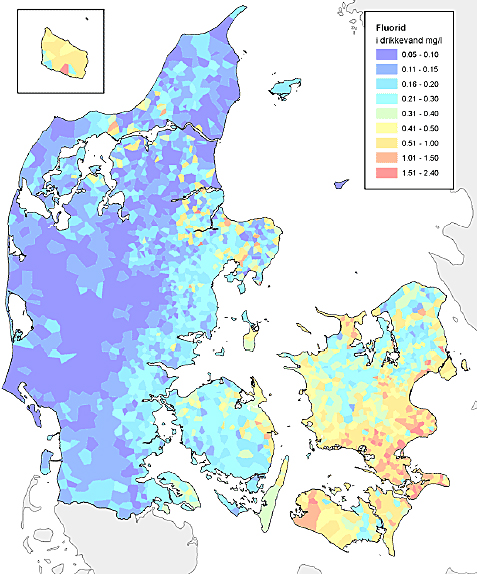
Fluorkoncentrationen in the tap water that comes out of the taps in the home, can have a crucial impact on their children's cariesrisiko. Children who live in Siberia, are twice as likely to get tooth decay as children living in the southeastern part of Zealand and on Lolland-Falster, Møn and Bornholm, where fluorkoncentrationen is the highest.
There is a big difference in fluorkoncentrationen in the drinking water, depending on where you are in the country. If one lives as a child or young person in an area where there is a high concentration of fluoride in the drinking water, it may mean that the risk of getting cavities in the teeth can be half as great as in an area where fluorindholdet is low – for example in west Jutland, where the risk of getting holes in your teeth is up to twice as large as the areas where fluorkoncentrationen is a maximum. The more fluoride in the water, the fewer holes.
The survey is conducted among 48.351 children 5-years of age and 43.848 15-year-olds in the entire country.
Here you can see what fluorindholdet in the drinking water is in your area. Click on the image to see the bigger picture.
Read more in Tandlægebladet no. 6 2010 or on the www.tandlaegebladet.dk
”Sweet” cultural background affects children cariesrisiko
10. april 2010
Filed in News
If the mother and father have a short education or non-western background, the risk of caries in children is significantly larger than that of the average. It shows a new Norwegian study, published in Community Dentistry and Oral Epidemiology.
In the survey received 523 children made tandundersøgelse, while the parents responding to questions about the socio-economic conditions and on own tandplejevaner. In the group of parents with non-western background and education had the children, respectively, nine and twelve times more at risk for incipient caries in the enamel and tandbenet. This is due to excessive sugar intake, and lacked regular brushing.
Non-western background and education
“In the group of parents with non-western background and education had the children, respectively, nine and 12 times as likely to have incipient caries in enamel and in dentin. However, the confidence intervals for these probabilities was quite large, ie. uncertain and one should also notice that it is about 24 children out of a total of 523”, says Dorthe Holst, professor of samfundsodontologi at Oslo University, and adds: